Hannah Baker—Mr. Porter
Thirteen Reasons WhyHannah Baker—Mr. Porter is the relationship between a student in acute distress and the school adult she finally approaches for help. Its decisive significance lies in the gap between recognition and effective intervention: Mr. Porter tells Hannah Baker that he believes her and that something must change, yet their conversation ends without a plan she can accept, and she concludes that no one is stepping forward to stop her.
Identity and Context
Mr. Porter is both Hannah Baker’s first-period English teacher and the guidance counselor assigned to students whose last names fall from A through G. Because Hannah and Mr. Porter share English class, he is already part of her daily school life; the counselor role makes him, at the same time, a person formally positioned to hear students’ difficulties. The overlap gives their relationship unusual weight: Hannah is not turning to an unknown adult, but to someone she sees every day and who has an institutional responsibility to advise her.
Before the meeting, Hannah’s account identifies Mr. Porter as the last person standing between the listeners and the collection of audiotapes. The prospect of involving him alarms Clay Jensen. Hannah and Mr. Porter have him for first-period English, and Clay does not want him to know about the tapes or about what has happened. Bringing an adult from school into the matter exceeds what Clay imagined would happen. That resistance frames the encounter as a threshold: the story moves from private disclosures carried on tape to a direct appeal to a school counselor.
The Meeting and Hannah’s State
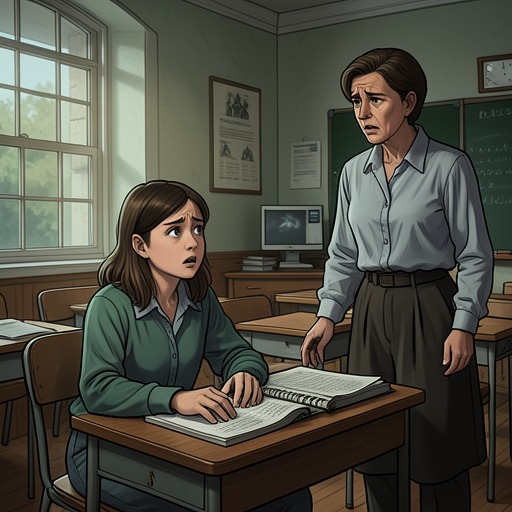
In the counseling conversation, Mr. Porter invites Hannah to sit and asks whether she is comfortable or would like water. Hannah answers politely that she is fine. The exchange begins with ordinary gestures of care, but her answers soon make clear how little those courtesies can reach. Asked how she feels, she describes herself as lost and empty, then says she does not care anymore. When Mr. Porter asks what she needs that she is not getting, Hannah answers that she needs everything to stop—people and life.
Her account also gives the encounter a crucial distinction between wanting relief and wanting death. Hannah says she does not want her life to end and explains that this is why she has come to him. The statement is a direct opening for intervention: she is there because some part of her is seeking help, even as she describes an overwhelming wish for everything to stop. Mr. Porter asks how they arrived at this point, while Hannah challenges the shared framing of the question, asking whether the issue is how they got there or how she got there. The difference matters. His language proposes a problem they might address together; her reply registers how alone the burden feels to her.
Advice, Limits, and Conflict
Mr. Porter says that something needs to be done and that something needs to change for Hannah. He asks what they can do to solve the problem together. Hannah answers that it is over, then asks him to tell her what options she has. The exchange shows both her exhaustion and her request for direction: she is not merely reporting pain but asking the adult across from her to identify a way forward.
The options Mr. Porter offers are conditional. If Hannah will not press charges and is unsure whether she can, and if she will not confront the person involved, he says she needs to consider the possibility of moving beyond what happened. He also says that doing nothing is an option and tells her, “I believe you.” These statements coexist uneasily. His belief acknowledges that Hannah experienced something wrong, while the choices he outlines place the next steps on her: pursue charges, confront the person, or consider moving beyond it. Hannah rejects the last possibility with an urgent challenge, asking what happens if moving beyond it is not possible. The conversation thus turns on a mismatch between Mr. Porter’s proposed routes and Hannah’s sense that she cannot take them.
The limits of the meeting are sharpened by what Hannah says about the person who should act. Mr. Porter asks what they can do together, but Hannah says she needs him to tell her what her options are. When the available paths fail to answer her need, the word “together” does not become a workable shared action. The scene does not establish that Mr. Porter disbelieves her; on the contrary, he explicitly says he believes her. Its failure is more specific and more painful: recognition is present, but Hannah does not experience the response as a sufficient way out.
Consequences and Narrative Significance
As Hannah leaves, she says that she thinks she has made herself very clear, but that no one is stepping forward to stop her. She adds that many people cared, but not enough, and describes that as what she needed to find out. The conclusion turns the counseling session into a judgment on care measured by action. Mr. Porter’s role is central to that judgment because he is at once Hannah’s teacher, counselor, and the adult she has approached after deciding that she needs help.
The relationship’s significance is not that Mr. Porter is shown as indifferent in every respect: he listens, asks questions, offers water, says he believes Hannah, and acknowledges that change is needed. Rather, the scene places those gestures beside Hannah’s unrelieved despair and her final perception that nobody stepped forward. The contrast makes the encounter a study of the distance between hearing a disclosure and answering it in a way the person in crisis can use. Through Mr. Porter, Hannah’s account brings the school’s adult support system into the chain of events—not as a simple absence of concern, but as a response that does not prevent her from leaving convinced that she is still alone.